


All Categories





Quick Links
- About us
- CE Marking Certification
- Impartiality Statement
- Founder
- Quality Policy
- ISO Application Process
- Certified Client
- Accredited Certificate Need to be Converted
- History
Read More
ISO 14001:2026 Certification
At-a-Glance: ISO 14001:2026 Key Facts
| Parameter | Value |
|---|---|
| Standard Number | ISO 14001:2026 |
| Title | Environmental Management Systems — Requirements with guidance for use |
| Edition | 4th edition |
| Publication Date | April 2026 |
| Replaces | ISO 14001:2015 |
| Transition Period | 3 years (indicative, pending IAF MD confirmation) |
| Last Date to Transition | April / May 2029 (to be confirmed) |
| Certifying Body | TNV Global Limited |
| Accreditation | UAF (IAF MLA signatory) |
Introduction to ISO 14001:2026
What is ISO 14001:2026?
ISO 14001:2026 is the latest edition of the world's leading Environmental Management System (EMS) standard. It provides a systematic framework for organisations of any size and sector to manage their environmental responsibilities, reduce environmental impact, improve resource efficiency, and demonstrate environmental commitment to customers, regulators, and stakeholders.
The 2026 edition strengthens the standard's relevance in a world where climate change, biodiversity loss, pollution, and resource scarcity are urgent business and regulatory priorities. It equips organisations with the tools to integrate environmental management into their core strategy — not as a side exercise, but as a driver of resilience and competitive advantage.
Purpose and Scope of the New Standard
ISO 14001:2026 specifies the requirements for an environmental management system that an organisation can use to enhance its environmental performance. It is intended for organisations seeking to manage their environmental responsibilities in a systematic manner that contributes to the environmental pillar of sustainability.
The standard is applicable to any organisation regardless of size, type, nature, or sector. It applies to the environmental aspects of the organisation's activities, products, and services that it can control or influence, considering a life cycle perspective.
Who Should Adopt ISO 14001:2026?
ISO 14001:2026 is relevant to every organisation that has environmental aspects to manage. This includes manufacturing companies, service organisations, construction firms, healthcare institutions, educational establishments, government agencies, IT companies, food and beverage producers, pharmaceutical companies, energy companies, logistics providers, and any organisation seeking to demonstrate environmental responsibility.
Organisations already certified to ISO 14001:2015 must transition to ISO 14001:2026 within the transition period defined by the IAF. New applicants should apply directly for ISO 14001:2026 certification.
Evolution of ISO 14001
| 1996 | First edition — environmental management system framework established |
| 2004 | Second edition — clarifications, improved compatibility with ISO 9001 |
| 2015 | Third edition — Annex SL alignment, risk-based thinking, leadership commitment, life cycle perspective introduced |
| 2026 | Fourth edition — climate change, biodiversity, Clause 6.3 change management, expanded life cycle perspective, externally provided processes |
New Structure of ISO 14001:2026
Alignment with the Harmonized Structure (Annex SL)
ISO 14001:2026 continues to follow the Harmonized Structure (HS), formerly known as Annex SL. This high-level framework ensures a common architecture across all ISO management system standards. The HS provides identical core text, terms, and definitions, enabling seamless integration with ISO 9001:2015 (or the upcoming ISO 9001:2026), ISO 45001:2018, ISO 27001:2022, ISO 50001:2018, and other management system standards.
For organisations running Integrated Management Systems (IMS), this means a single documentation framework, a single audit programme, and a coherent approach to leadership, risk, and continual improvement across quality, environment, and health and safety.
Clause-by-Clause Map (Clauses 4 to 10)
| Clause | Title | Key Focus in 2026 |
|---|---|---|
| Clause 4 | Context of the Organisation | Understanding the organisation, interested parties, scope, and EMS — now explicitly includes climate change, biodiversity, pollution, and resource scarcity |
| Clause 5 | Leadership | Top management commitment and accountability — extended to all relevant management roles |
| Clause 6 | Planning | Risks, opportunities, environmental objectives — new Clause 6.3 for planning and managing changes |
| Clause 7 | Support | Resources, competence, awareness, communication, documented information — terminology updates |
| Clause 8 | Operation | Operational planning, emergency preparedness — explicit coverage of externally provided processes, products, or services |
| Clause 9 | Performance Evaluation | Monitoring, measurement, analysis, internal audit, management review — internal audit must now define specific objectives |
| Clause 10 | Improvement | Nonconformity, corrective action, continual improvement |
Integration with ISO 9001:2015 and ISO 45001:2018
ISO 14001:2026 is fully compatible with ISO 9001:2015 (and the upcoming ISO 9001:2026) and ISO 45001:2018 through the shared Harmonized Structure. Organisations operating integrated management systems benefit from aligned clause numbering, common terminology, and a shared approach to leadership, documented information, internal audit, and management review.
TNV Global Limited offers combined audit programmes covering QMS + EMS + OHSMS, allowing organisations to transition their EMS to ISO 14001:2026 alongside their routine quality and safety audits — reducing cost, audit days, and management disruption.
Core Changes in ISO 14001:2026 (Clause-by-Clause)
Clause 4 — Context of the Organisation
(a) The organisation must now explicitly consider climate change, biodiversity, pollution, and resource scarcity when determining external and internal issues relevant to the EMS.
(b) Interested parties' requirements may now include expectations related to climate action, biodiversity protection, and responsible resource use.
(c) The scope of the EMS must reflect these broader environmental considerations, ensuring the system addresses the full spectrum of environmental challenges the organisation faces.
Clause 5 — Leadership
(a) Top management accountability for the effectiveness of the EMS has been extended to all relevant management roles — not just the most senior executive.
(b) Leadership must ensure that environmental management is integrated into the organisation's business processes, strategic direction, and decision-making.
(c) The environmental policy must reflect the organisation's commitment to addressing climate change and other significant environmental issues.
Clause 6 — Planning (New Sub-clause 6.3)
(a) Clause 6.3 — Planning and Managing of Changes is a new requirement. Organisations must plan for changes that could affect the EMS — whether operational, structural, technological, or regulatory — and manage the transition in a controlled manner.
(b) This brings ISO 14001:2026 into alignment with change management best practice and mirrors similar requirements in ISO 9001 and ISO 45001.
(c) Risk and opportunity assessment must now consider the implications of climate change, biodiversity loss, and resource scarcity when setting environmental objectives.
Clause 7 — Support
(a) Terminology has been updated and standardised across the standard for consistency with the Harmonized Structure.
(b) Requirements for competence, awareness, communication, and documented information remain largely consistent with ISO 14001:2015, with minor wording clarifications.
(c) Organisations must ensure that all persons doing work under the organisation's control are aware of the environmental policy and their contribution to the effectiveness of the EMS — including the implications of not conforming.
Clause 8 — Operation
(a) Externally provided processes, products, or services are now explicitly addressed. Organisations must establish controls or influence over environmental aspects associated with outsourced activities, procured products, and contracted services.
(b) This is a significant expansion for organisations with complex supply chains — environmental control now extends beyond the organisation's own operations.
(c) Emergency preparedness and response requirements have been strengthened, with a clearer link to the risk and opportunity framework in Clause 6.
(d) The life cycle perspective has been expanded — organisations must consider environmental aspects from raw material acquisition through production, use, and end-of-life treatment.
Clause 9 — Performance Evaluation
(a) Internal audits must now define specific audit objectives for each audit — moving beyond a generic programme description.
(b) The effectiveness of the EMS must be evaluated, not just its conformity.
(c) Management review inputs have been expanded to include results of risk and opportunity assessment, environmental performance trends, and relevant changes in the external context.
Clause 10 — Improvement
(a) Continual improvement requirements remain consistent with ISO 14001:2015.
(b) Organisations are encouraged to consider innovation, breakthrough change, and reorganisation as valid forms of improvement — alongside incremental continual improvement.
Life Cycle Perspective — Expanded Application
The life cycle perspective, introduced in ISO 14001:2015, is expanded in the 2026 edition. Organisations must consider environmental aspects across the full life cycle — from raw material extraction, through design, production, distribution, use, and end-of-life treatment, including recycling, reuse, and disposal.
This requirement applies to the identification of significant environmental aspects, the setting of environmental objectives, and the control of operations — including procurement and outsourced processes.
The life cycle perspective does not require a formal Life Cycle Assessment (LCA) — but organisations must demonstrate that they have considered life cycle stages when managing their environmental aspects.
Key Terminology Updates
(a) "Externally provided processes, products or services" replaces references to outsourced processes in several places, aligning with ISO 9001 terminology.
(b) "Meet" replaces "fulfil" in several compliance-related clauses, aligning with broader ISO conventions.
(c) Documented information requirements use standardised phrasing: "documented information shall be available as evidence of" throughout.
(d) "Biodiversity" and "resource scarcity" are explicitly named for the first time.
Whats New in ISO 14001:2026 — Complete List
(a) New Clause 6.3 — Planning and Managing of Changes: Organisations must plan for and manage changes that could affect the EMS in a structured, controlled manner.
(b) Explicit climate change integration: Climate change must be considered as a relevant issue in the context of the organisation and in risk and opportunity assessment.
(c) Biodiversity and resource scarcity: These are explicitly named as environmental issues to be considered when determining the context of the organisation.
(d) Externally provided processes, products, or services: Explicit operational control requirements extend to outsourced activities, procured products, and contracted services.
(e) Expanded life cycle perspective: Life cycle thinking must be applied across aspect identification, objective setting, and operational control — including procurement and supply chain.
(f) Internal audit objectives: Each internal audit must define specific objectives, criteria, and scope — not rely on a generic annual programme.
(g) Extended leadership accountability: Top management accountability for EMS effectiveness is extended to all relevant management roles.
(h) Standardised terminology: "Externally provided processes," "meet" replacing "fulfil," and standardised documented information phrasing throughout.
(i) Stronger supplier and outsourced process control: Organisations must establish controls or influence over the environmental aspects of externally provided processes, products, and services.
(j) Emergency preparedness under risks and opportunities: Emergency preparedness and response is more closely linked to the risk and opportunity framework in Clause 6.
(k) Pollution and resource scarcity recognised: Pollution prevention and resource scarcity are reinforced as core environmental issues alongside climate change and biodiversity.
ISO 14001:2015 vs ISO 14001:2026 — Side-by-Side Comparison
| Area | ISO 14001:2015 | ISO 14001:2026 |
|---|---|---|
| Climate Change | Not explicitly required | Climate change must be explicitly considered in context and risk assessment |
| Biodiversity | Not named | Biodiversity explicitly recognised as a relevant environmental issue |
| Resource Scarcity | Implied through resource use | Explicitly named as an issue to consider |
| Change Management | No dedicated clause | New Clause 6.3 — Planning and Managing of Changes |
| Life Cycle Perspective | Introduced but limited in scope | Expanded across aspect identification, objectives, and operational control |
| Outsourced Processes | Referenced generally | Explicit requirements for externally provided processes, products, or services |
| Leadership Accountability | Top management responsible | Accountability extended to all relevant management roles |
| Emergency Preparedness | Standalone clause | Linked to risks and opportunities framework |
| Internal Audit | Programme-based approach | Each audit must define specific objectives, criteria, and scope |
| Terminology | "Fulfil," "outsourced processes" | "Meet," "externally provided processes, products or services" |
| Documented Information | Varied phrasing | Standardised: "documented information shall be available as evidence of" |
| IMS Alignment | Annex SL (2015 version) | Updated Harmonized Structure; improved alignment with ISO 9001 and ISO 45001 |
Advantages of ISO 14001:2026
Environmental & Sustainability Benefits
(a) Embedding climate change, biodiversity, and resource scarcity into the EMS ensures environmental management reflects today's most urgent global challenges.
(b) The expanded life cycle perspective drives reduction of environmental impact across the entire value chain — from raw materials to end-of-life.
(c) Stronger supplier and outsourced process controls extend environmental responsibility beyond the organisation's own fence line.
(d) Systematic emergency preparedness reduces the risk and impact of environmental incidents.
Business & Commercial Benefits
(a) ISO 14001:2026 certification demonstrates environmental leadership to customers, investors, regulators, and the public.
(b) Proactive climate change and biodiversity management positions the organisation favourably for ESG reporting, green finance, and sustainability-linked procurement.
(c) Clause 6.3 change management ensures that organisational changes are managed without compromising environmental performance.
(d) Reduced waste, improved resource efficiency, and better supplier control translate directly into cost savings.
Regulatory & Compliance Benefits
(a) The standard helps organisations stay ahead of evolving environmental legislation, including climate-related disclosure requirements.
(b) Systematic identification and management of compliance obligations reduces the risk of regulatory penalties, fines, and reputational damage.
(c) A certified EMS provides documented evidence of due diligence in environmental management — valuable in regulatory audits and legal proceedings.
Integrated Management System Benefits
(a) Full compatibility with ISO 9001 and ISO 45001 through the Harmonized Structure.
(b) Combined audit programmes reduce audit days, cost, and management disruption.
(c) Shared documentation, shared internal audits, and a single management review process across QMS, EMS, and OHSMS.
(d) A coordinated transition to ISO 14001:2026 alongside ISO 9001:2026 eliminates duplication.
Limitations & Challenges of ISO 14001:2026
A balanced view is essential. Organisations should be aware of the following challenges:
(a) Implementation cost and documentation burden can be significant for small and medium enterprises, particularly around the new life cycle perspective and externally provided processes requirements.
(b) Retraining of internal auditors and top management is required — existing ISO 14001:2015 audit skills are necessary but not sufficient for the 2026 edition.
(c) Limited maturity of the auditor pool during the initial transition period may lead to inconsistencies in audit practice across the industry.
(d) The standard remains qualitative on climate metrics — it does not mandate specific numerical targets for emissions reduction, carbon footprint, or energy consumption.
(e) Overlap with other climate and sustainability frameworks may create reporting fatigue for organisations managing multiple disclosures.
(f) Life cycle perspective can be resource-intensive for organisations with extended, multi-tier supply chains — particularly where supplier data is limited or unreliable.
Transition Timeline — ISO 14001:2015 to 2026
Official ISO / IAF Milestones
(a) April 2026: ISO 14001:2026 published as a final International Standard.
(b) IAF mandatory transition document: Expected shortly after publication — will define the official transition period, typically three years.
(c) Indicative transition deadline: April / May 2029, to be confirmed upon IAF MD publication.
TNV Global Limited Transition Timeline
(Dates to be finalised by the TNV Global Technical Committee upon IAF MD publication)
(a) Immediate: TNV Global accepts transition audit applications under ISO 14001:2026.
(b) [Date TBC]: Last date for new applications under ISO 14001:2015.
(c) [Date TBC]: Last date for transition audits to be completed.
(d) [Date TBC]: All ISO 14001:2015 certificates become inactive if not transitioned.
Last Date for New Applications Under ISO 14001:2015
TNV Global will announce a specific cut-off date after which all new applications must be submitted under ISO 14001:2026. Organisations planning initial certification should contact TNV Global to confirm the applicable standard.
Last Date for Transition Audit
All existing ISO 14001:2015 certificate holders must complete their transition audit before the deadline defined in the IAF mandatory document. TNV Global strongly recommends scheduling the transition audit at least six months before the deadline to allow time for corrective actions if non-conformities are identified.
Certificate Expiry, Suspension & Cancellation Schedule
Organisations that fail to complete the transition within the defined period risk having their ISO 14001:2015 certificate marked as inactive, suspended, and ultimately cancelled on IAF CertSearch. This has direct business consequences — customers, regulators, and tender evaluation committees verify certificate status online.
When Should a Client Request Transition?
The best time to transition depends on your current certification cycle:
(a) If your next surveillance audit (Year 1 or Year 2) is due within the transition period: Request a combined surveillance + transition audit. This is the most efficient and cost-effective approach.
(b) If your recertification audit is due within the transition period: Combine the recertification with the transition. Your new certificate will be issued directly under ISO 14001:2026.
(c) If you are undergoing a scope change or major organisational change: Use the occasion to transition simultaneously — the audit planning already accounts for significant changes.
(d) TNV Global's recommended window: Start your transition at the earliest convenient audit event. Early adopters benefit from more flexible scheduling and auditor availability.
How to Plan Your ISO 14001:2026 Transition — Step by Step
(1) Obtain the official copy of ISO 14001:2026 from the ISO online store or your national standards body.
(2) Perform a gap analysis against the new requirements — compare your existing ISO 14001:2015 system with the 2026 edition clause by clause.
(3) Update your context of the organisation — add climate change, biodiversity, pollution, and resource scarcity to your external/internal issues assessment.
(4) Revise your EMS documentation — update the environmental manual, procedures, work instructions, and forms to reflect new and changed requirements.
(5) Update your aspect-impact register with an expanded life cycle perspective — consider raw material acquisition, production, distribution, use, and end-of-life.
(6) Implement a Clause 6.3 change management procedure — establish a process for planning and managing changes that could affect the EMS.
(7) Conduct a top management briefing — ensure leadership understands their expanded accountability and the new requirements.
(8) Train your internal auditors on ISO 14001:2026 — auditors must understand the new clauses, terminology, and audit objective requirements.
(9) Conduct an internal audit against ISO 14001:2026 and close out corrective actions.
(10) Hold a management review that addresses the updated inputs required by ISO 14001:2026.
(11) Apply to TNV Global for your transition audit — submit the Transition Application Form at least 60 days before your preferred audit date.
Things to Verify Before Applying for ISO 14001:2026
Before submitting your transition application to TNV Global, verify the following:
(a) Your EMS documentation has been updated to reflect ISO 14001:2026 requirements.
(b) Your context analysis includes climate change, biodiversity, pollution, and resource scarcity.
(c) Your aspect-impact register has been updated with an expanded life cycle perspective.
(d) You have implemented a Clause 6.3 change management procedure.
(e) Your environmental objectives have been reviewed and updated where necessary.
(f) Controls for externally provided processes, products, or services have been established.
(g) Emergency preparedness and response procedures have been reviewed against the updated risk framework.
(h) Internal auditors have been trained on ISO 14001:2026.
(i) At least one internal audit has been conducted against ISO 14001:2026 requirements.
(j) A management review covering ISO 14001:2026 inputs has been completed.
(k) Any non-conformities from the internal audit have been addressed with corrective actions.
(l) The Transition Application Form has been completed and signed by top management.
Additional Documents Clients Should Prepare
(a) Updated Environmental Manual (if your organisation maintains one).
(b) Context analysis including climate change, biodiversity, pollution, and resource scarcity.
(c) Revised aspect-impact register with expanded life cycle perspective.
(d) Change management procedure (new Clause 6.3).
(e) Updated emergency preparedness and response procedures.
(f) Revised risk and opportunity register reflecting new environmental issues.
(g) Updated list of externally provided processes, products, or services with associated environmental controls.
(h) Internal audit plan and records aligned to ISO 14001:2026.
(i) Internal auditor training records demonstrating ISO 14001:2026 competence.
(j) Updated management review records covering all ISO 14001:2026 inputs.
Transition Audit — What TNV Global Assesses
Scope of Transition Audit
The transition audit verifies that your EMS conforms to all requirements of ISO 14001:2026. The audit covers the full scope of your existing certification and focuses specifically on the new and changed requirements — Clause 4, Clause 6.3, Clause 8, life cycle perspective, internal audit objectives, and terminology updates.
Audit Duration
Audit duration is based on the size and complexity of your organisation, the number of sites, and the scope of your EMS. TNV Global follows IAF mandatory document guidelines for audit duration. Typical transition audits require 1–3 additional audit days above the normal surveillance duration — this can be reduced if combined with a scheduled audit.
Combined with Surveillance vs Stand-alone
TNV Global strongly recommends combining the transition audit with your next scheduled surveillance or recertification audit. This minimises audit days, travel costs, and management disruption. A stand-alone transition audit is available for organisations that prefer to transition outside their normal cycle.
On-site vs Remote Options
Transition audits for ISO 14001:2026 are primarily conducted on-site, as the standard requires verification of operational controls, emergency preparedness, and environmental aspects at the actual workplace. Limited remote audit elements may be considered for document review and management interviews, subject to TNV Global's remote audit policy and IAF MD 4 requirements.
Non-conformity Handling
If non-conformities are identified during the transition audit, TNV Global applies its standard non-conformity management process. Major non-conformities must be resolved before a positive certification decision can be made. Minor non-conformities must be addressed within the agreed timeframe. The transition deadline is not a basis for waiving non-conformity resolution.
Certification Decision and Certificate Issuance
Following a successful transition audit and resolution of any non-conformities, TNV Global's Certification Committee makes the certification decision. Upon approval, a new ISO 14001:2026 certificate is issued and registered on IAF CertSearch.
Validity Alignment with Existing Cycle
The new ISO 14001:2026 certificate is aligned with your existing certification cycle wherever possible. This avoids disruption to your audit schedule and ensures continuity of certification.
How to Apply — Transition Application Form
Download Transition Application Form
Download the ISO 14001:2026 Transition Application Form from: www.isoindia.org/iso_downloads.php
How to Submit
Complete the form, have it signed by top management, and submit to TNV Global via email, the online enquiry form, or through your assigned Client Manager. Submit at least 60 days before your preferred audit date.
Quotation and Contract Signing
TNV Global will issue a quotation based on your organisation's size, number of sites, and scope. Upon acceptance, a contract amendment or new contract will be issued.
Audit Scheduling
Once the contract is signed, TNV Global's scheduling team will coordinate audit dates, auditor assignment, and logistics in consultation with your organisation.
Download Transition Application FormPreparing Your Internal Auditors for ISO 14001:2026
Competency Requirements (ISO 19011 Alignment)
Internal auditors must have competence in the requirements of ISO 14001:2026, audit principles and techniques, and the sector-specific environmental aspects relevant to your organisation. Auditors trained under ISO 14001:2015 will need transition training to cover the new and changed clauses.
New Clauses Auditors Must Master
(a) Clause 4 — Climate change, biodiversity, pollution, resource scarcity in context
(b) Clause 6.3 — Planning and managing of changes
(c) Clause 8 — Externally provided processes, products, or services
(d) Life cycle perspective — expanded application across aspects, objectives, and operational control
(e) Internal audit objective setting — per-audit objectives, not just generic programme goals
ISO 14001:2026 Lead Auditor / Transition Course
TNV Global's in-house training arm offers the ISO 14001:2026 Lead Auditor course and the ISO 14001:2026 Transition course. Contact TNV Global for course schedules, fees, and group booking options.
Training enquiries: www.isoindia.org/traning.php
Suggested Internal Audit Checklist
TNV Global will publish a downloadable ISO 14001:2026 internal audit checklist to assist organisations in preparing for the transition. Check the downloads page for availability: www.isoindia.org/iso_downloads.php
Auditor Calibration & Briefing Sessions
TNV Global can arrange auditor calibration and briefing sessions for your internal audit team — either on-site or via webinar. Contact your Client Manager or submit an enquiry.
Training EnquiriesISO DownloadsIntegrated Management System (IMS) Transition — QMS + EMS + OHSMS
Why Transition QMS, EMS, and OHSMS Together
Organisations holding multiple certifications benefit significantly from a coordinated transition approach. When ISO 14001:2026 is being transitioned, it makes practical sense to review the entire integrated management system at the same time — especially if ISO 9001:2026 is also published in the same period.
Combined Audit Approach
TNV Global offers combined audits covering ISO 9001 + ISO 14001:2026 + ISO 45001 in a single visit. This approach reduces total audit days, minimises operational disruption, and provides a holistic view of the management system's effectiveness.
Time and Cost Savings
A combined IMS audit typically requires 20–30% fewer audit days than separate standard-specific audits. Travel costs, management time, and preparation effort are reduced proportionally.
Common Clauses and Alignment Map
Under the Harmonized Structure, Clauses 4, 5, 6, 7, 9, and 10 share identical high-level requirements across ISO 9001, ISO 14001, and ISO 45001. Clause 8 is standard-specific but can be audited through integrated operational processes.
Integrated Documentation Strategy
A single management system manual, shared procedures for document control, internal audit, management review, corrective action, and competence management reduce duplication. Standard-specific procedures sit within the integrated framework.
TNV Global's IMS Audit Methodology
TNV Global's Lead Auditors are qualified across multiple standards. The IMS audit methodology ensures each standard's requirements are fully covered while maximising the efficiency of shared clause assessment.
When Will TNV Global Stop Accepting New Applications Under ISO 14001:2015?
TNV Global will announce a specific cut-off date after which all new EMS certification applications must be submitted under ISO 14001:2026. This date will be aligned with the IAF mandatory transition document.
Organisations currently in the application or audit process under ISO 14001:2015 should contact TNV Global to discuss the most efficient path — in many cases, applying directly under ISO 14001:2026 will avoid the need for a separate transition audit later.
Status of ISO 14001:2015 Certificates After the Transition Deadline
When Certificates Become INACTIVE
After the transition deadline, ISO 14001:2015 certificates that have not been transitioned to ISO 14001:2026 will be marked as inactive on IAF CertSearch. An inactive certificate is no longer valid for demonstrating conformity to customers, regulators, or tender evaluation committees.
When Certificates Get SUSPENDED
If no transition application has been received within a defined period after the deadline, TNV Global may suspend the certificate. A suspended certificate is not valid and the organisation cannot claim certification.
When Certificates Get CANCELLED / WITHDRAWN
If no transition is completed within the maximum allowed period, the certificate is cancelled and withdrawn from IAF CertSearch. The organisation must apply for a fresh initial certification under ISO 14001:2026 — a significantly more time-consuming and costly process than a transition audit.
Business Impact and How to Avoid Loss of Certification
Loss of certification can result in disqualification from tenders, loss of customer contracts, regulatory non-compliance, and reputational damage. The simplest way to avoid this is to schedule your transition audit early within the transition period.
IAF CertSearch Visibility Changes
All certificate status changes — active, inactive, suspended, withdrawn — are reflected in real-time on IAF CertSearch. Customers, regulators, and procurement teams can verify certificate status at any time.
Why Choose TNV Global Limited for ISO 14001:2026
TNV Global Limited is a UAF-accredited, IAF MLA-recognised certification body with a global presence in over 120 countries. Our credentials and experience make us the trusted partner for ISO 14001:2026 certification and transition.
(a) UAF Accreditation: UAF is a signatory to the IAF Multilateral Recognition Arrangement (MLA), ensuring your ISO 14001:2026 certificate is recognised internationally.
(b) Global Presence: Certification services in India and 120+ countries across the Middle East, Southeast Asia, Africa, Europe, and the Americas.
(c) In-house Training Arm: Lead Auditor, Internal Auditor, Transition, and Awareness training courses for ISO 14001 and related standards.
(d) Industry Expertise: Deep experience across manufacturing, services, pharmaceuticals, healthcare, education, construction, IT, food, and energy sectors.
(e) Integrated Audit Capability: Combined audits for ISO 9001, ISO 14001, ISO 45001, ISO 27001, ISO 50001, and other management system standards.
(f) Certificate Verification: All TNV Global-issued certificates are verifiable on IAF CertSearch, the global directory of accredited certifications.
Verify any TNV Global certificate: www.iaf.nu/certsearch
Verify Any TNV Global CertificateFrequently Asked Questions (FAQ)
Below are some of the most common questions organisations, consultants, auditors, and certification applicants may have regarding ISO 14001:2026.
Q1. What is ISO 14001:2026?
ISO 14001:2026 is the fourth edition of the international Environmental Management System standard, published by ISO in April 2026. It replaces ISO 14001:2015 and introduces updated requirements for climate change, biodiversity, life cycle perspective, change management, and externally provided processes.
Q2. When was ISO 14001:2026 published?
ISO 14001:2026 was published in April 2026. It is now the current edition of the ISO 14001 standard and is available for certification and transition.
Q3. What is the transition period for ISO 14001:2026?
The transition period is expected to be three years from the date of publication, as is standard practice for ISO management system revisions. The exact deadline will be confirmed in the IAF mandatory transition document.
Q4. When will ISO 14001:2015 certificates expire?
ISO 14001:2015 certificates will cease to be valid at the end of the transition period — indicatively April/May 2029. Organisations must complete their transition audit before this deadline to maintain certification.
Q5. What are the key changes in ISO 14001:2026 compared to ISO 14001:2015?
Key changes include explicit climate change and biodiversity integration, a new Clause 6.3 for change management, expanded life cycle perspective, explicit control of externally provided processes, per-audit internal audit objectives, and extended leadership accountability.
Q6. Is ISO 14001:2026 a major revision or a minor update?
ISO 14001:2026 is a significant revision. While the Harmonized Structure is retained, the standard introduces new clauses, new environmental issues, expanded operational control requirements, and updated terminology.
Q7. What is the new Clause 6.3 in ISO 14001:2026?
Clause 6.3 requires organisations to plan for and manage changes that could affect the EMS. This includes operational, structural, technological, and regulatory changes. The clause ensures changes are implemented in a controlled manner without compromising environmental performance.
Q8. How does ISO 14001:2026 address climate change?
Climate change must be explicitly considered when determining the context of the organisation and when assessing risks and opportunities. Interested parties may have climate-related requirements that must be identified and addressed within the EMS.
Q9. What is the life cycle perspective requirement in ISO 14001:2026?
Organisations must consider environmental aspects across the full product or service life cycle — from raw material acquisition through production, distribution, use, and end-of-life treatment. This applies to aspect identification, objective setting, and operational control. A formal Life Cycle Assessment is not required.
Q10. Can I still apply for ISO 14001:2015 certification from TNV Global?
During the early transition period, TNV Global may still accept new applications under ISO 14001:2015. However, a specific cut-off date will be announced. New applicants are strongly encouraged to apply directly under ISO 14001:2026 to avoid the need for a separate transition later.
Q11. Until when will TNV Global accept new applications under ISO 14001:2015?
A specific cut-off date will be announced by TNV Global, aligned with the IAF mandatory transition document. Contact TNV Global for the latest information.
Q12. How long does the ISO 14001:2026 transition audit take?
The transition audit typically requires 1–3 additional audit days above the normal surveillance duration, depending on the size and complexity of the organisation. This can be reduced if combined with a scheduled surveillance or recertification audit.
Q13. How much does the ISO 14001:2026 transition cost with TNV Global?
The cost depends on the organisation's size, number of sites, and scope of the EMS. TNV Global will provide a quotation upon receipt of the Transition Application Form. Combining the transition with a scheduled audit reduces the incremental cost.
Q14. Can the transition audit be combined with my surveillance audit?
Yes. TNV Global strongly recommends combining the transition audit with your next scheduled surveillance or recertification audit. This is the most efficient approach in terms of cost, time, and management effort.
Q15. What happens if I don't transition by the deadline?
If you do not complete the transition by the IAF-defined deadline, your ISO 14001:2015 certificate will be marked as inactive, then suspended, and ultimately cancelled on IAF CertSearch. You would need to apply for a fresh initial certification under ISO 14001:2026.
Q16. Can my ISO 14001:2015 certificate be suspended?
Yes. If no transition application is received within a defined period after the transition deadline, TNV Global may suspend the certificate. A suspended certificate is not valid and the organisation cannot claim ISO 14001 certification.
Q17. How do I prepare my internal auditors for ISO 14001:2026?
Internal auditors should complete ISO 14001:2026 transition training, study the new and changed clauses, and conduct at least one internal audit against ISO 14001:2026 before the transition audit.
Q18. Which documents do I need to update for ISO 14001:2026?
Key documents include the context analysis, aspect-impact register, risk and opportunity register, environmental objectives, change management procedure, emergency preparedness procedures, supplier and outsourced process controls, internal audit plan, and management review records.
Q19. Is TNV Global Limited accredited to issue ISO 14001:2026 certificates?
Yes. TNV Global Limited is accredited by UAF, an IAF MLA signatory. TNV Global is authorised to issue ISO 14001:2026 certificates that are recognised internationally through the IAF Multilateral Recognition Arrangement.
Q20. Can ISO 14001:2026 be integrated with ISO 9001 and ISO 45001?
Yes. ISO 14001:2026 follows the Harmonized Structure, making it fully compatible with ISO 9001 and ISO 45001. TNV Global offers combined IMS audits covering all three standards in a single visit.
Q21. What does "externally provided processes, products or services" mean?
This term refers to any process, product, or service provided by an external party that is within the scope of the organisation's EMS. The organisation must establish controls or influence over the environmental aspects associated with these externally provided elements.
Q22. Does ISO 14001:2026 require new environmental objectives?
Existing environmental objectives should be reviewed against the new requirements. New objectives may be needed to address climate change, biodiversity, life cycle perspective, and change management. Objectives must be measurable where practicable and consistent with the environmental policy.
Q23. Does ISO 14001:2026 cover biodiversity?
Yes. Biodiversity is explicitly named as a relevant environmental issue that organisations must consider when determining the context of the organisation and when identifying environmental aspects and impacts.
Q24. How does ISO 14001:2026 benefit Small and Medium Enterprises?
SMEs benefit from a structured approach to environmental management that improves efficiency, reduces waste, ensures regulatory compliance, and enhances credibility with customers and supply chain partners. The standard is scalable and applies proportional to size, environmental aspects, and resources.
Q25. Where can I download the ISO 14001:2026 transition application form?
The ISO 14001:2026 Transition Application Form is available for download at www.isoindia.org/iso_downloads.php. Complete the form and submit it to TNV Global at least 60 days before your preferred audit date.
Important Notes — For Clients, Partners & Auditors
NOTE FOR CLIENTS
Existing ISO 14001:2015 Certified Organisations
All existing ISO 14001:2015 certified clients of TNV Global Limited must begin preparing for transition to ISO 14001:2026 at the earliest opportunity. The transition period is limited, and delaying preparation may result in suspension or withdrawal of your certificate.
Action items for clients:
(a) Download the ISO 14001:2026 Transition Checklist and complete a self-assessment.
(b) Update your EMS documentation to address new requirements.
(c) Train internal auditors on ISO 14001:2026 before your internal audit cycle.
(d) Submit the Transition Application Form to TNV Global at least 60 days before your preferred audit date.
(e) If your next surveillance or recertification audit is due, ask TNV Global to combine it with the transition audit.
(f) For any clarification, contact TNV Global through the Enquiry form or your assigned Client Manager.
NOTE FOR PARTNERS
Franchisees, Associates, Business Development Partners
TNV Global's global partner network plays a central role in supporting clients through the ISO 14001:2026 transition. Partners are requested to ensure smooth communication and timely transition for all associated clients.
Action items for partners:
(a) Review the ISO 14001:2026 Partner Briefing Kit issued by TNV Global.
(b) Proactively inform all ISO 14001:2015 certified clients in your territory about transition timelines.
(c) Coordinate gap analysis and training support for clients where requested.
(d) Ensure that any new application received in your territory is submitted under ISO 14001:2026 after the official cut-off date.
(e) Report any client concerns or regulatory queries back to TNV Global Head Office at Lucknow.
For franchise and partnership queries: www.isoindia.org/apply_for_franchise.php
NOTE FOR AUDITORS
TNV Global Lead / Team Auditors
All TNV Global Lead Auditors and Team Auditors performing ISO 14001 audits must complete the ISO 14001:2026 transition training before conducting any audit under the new standard.
Action items for auditors:
(a) Complete the mandatory ISO 14001:2026 transition training organised by TNV Global.
(b) Update your personal auditor competence records and submit to TNV Global HR / Accreditation Cell.
(c) Familiarise yourself with the new Clause 6.3, revised life cycle perspective, expanded operational control, and new emergency preparedness under risks and opportunities.
(d) Use the updated ISO 14001:2026 audit checklist for all audits conducted after the official transition date.
(e) For integrated audits, confirm that the audit plan explicitly covers the 2026 clauses.
(f) Raise any interpretation queries through the Technical Committee before or during the audit.
(g) Auditors conducting transition audits must be specifically approved by the TNV Global Accreditation Cell after successful completion of the transition training.
Apply for FranchiseTNV Global Partners & Overseas Clients
Global Partner Network Overview
TNV Global Limited operates through a robust partner network spanning over 120 countries. From India to the Middle East, Southeast Asia, Africa, Europe, and the Americas, TNV Global's franchisees, associates, and business development partners deliver consistent, accredited certification services backed by the TNV Global Head Office in Lucknow, India.
Support for Partners During the ISO 14001:2026 Transition
(a) Partner Briefing Kit — comprehensive information pack on ISO 14001:2026 changes, transition timelines, and client communication guidelines.
(b) Co-branded transition webinars to help partners educate their local client base.
(c) Partner training discounts for ISO 14001:2026 Lead Auditor and Transition courses.
(d) Joint client visit support for strategic accounts planning their transition.
Become a TNV Global Partner
Apply for a TNV Global franchise or partnership: www.isoindia.org/apply_for_franchise.php
TNV Global's Overseas Certification Coverage
TNV Global issues IAF-recognised ISO 14001:2026 certificates across all regions where its accreditation scope applies. Clients worldwide receive certificates verifiable on IAF CertSearch.
Overseas services: www.isoindia.org/iso_overseas.php
Language Support and Local Auditor Availability
TNV Global provides multi-language audit support and maintains a panel of qualified local auditors in key regions, ensuring communication effectiveness and cultural understanding during assessments.
Cross-border Transition Coordination
For multi-site, multi-country organisations, TNV Global offers a single coordinated transition programme. One certification decision covering all sites simplifies global compliance and ensures consistency across regions.
Payment and Documentation for Overseas Clients
Payments are accepted through TNV Global and approved local partners. All certificates are issued digitally with IAF CertSearch registration for instant global verification.
Apply for a TNV Global Franchise Or PartnershipOverseas ServicesRelated Standards & Services
| Standard / Service | Description | Link |
|---|---|---|
| ISO 9001:2015 | Quality Management System | www.isoindia.org/iso-9001-Certification.php |
| ISO 45001:2018 | Occupational Health & Safety Management System | www.isoindia.org |
| ISO 27001:2022 | Information Security Management System | www.isoindia.org/iso-27001-certification-in-india.php |
| ISO 50001:2018 | Energy Management System | www.isoindia.org/iso_ISO_50001:2018.php |
| Lead Auditor Training | ISO 14001 Lead Auditor and Transition courses | www.isoindia.org/traning.php |
| Integrated Management System (IMS) | Combined QMS + EMS + OHSMS certification | www.isoindia.org |
Apply Now — Start Your ISO 14001:2026 Transition
START YOUR TRANSITION TODAY
TNV Global Limited is ready to support your ISO 14001:2026 transition. Apply now to secure your preferred audit dates and avoid the last-minute rush.
Submit an Enquiry: www.isoindia.org/iso_enquiry.php
Download Application Form: www.isoindia.org/iso_downloads.php
Call / WhatsApp: +91 9838070227
Email: info@isoindia.org
Regional offices and partner contact details available at: www.isoindia.org
Submit an EnquiryDownload Application FormReferences & Authoritative Sources
(a) ISO.org — Official ISO 14001 page: www.iso.org/standard/iso-14001
(b) IAF — Mandatory transition document: upon publication
(c) UAF Accreditation — TNV Global profile: www.isoindia.org/iso_uaf.php
(d) IAF CertSearch — TNV Global listing: www.iaf.nu/certsearch
(e) TNV Global Limited: www.isoindia.org
Disclaimer
Content on this page is based on ISO 14001:2026 as published in April 2026. Transition timelines, cut-off dates, and certificate validity schedules are indicative and subject to confirmation by the IAF mandatory transition document. TNV Global Limited will update this page when the official IAF transition requirements are published. For the most current information, contact TNV Global directly.
© TNV Global Limited. All rights reserved. UAF accredited, IAF MLA recognised. www.isoindia.org
- ISO 27001:2022
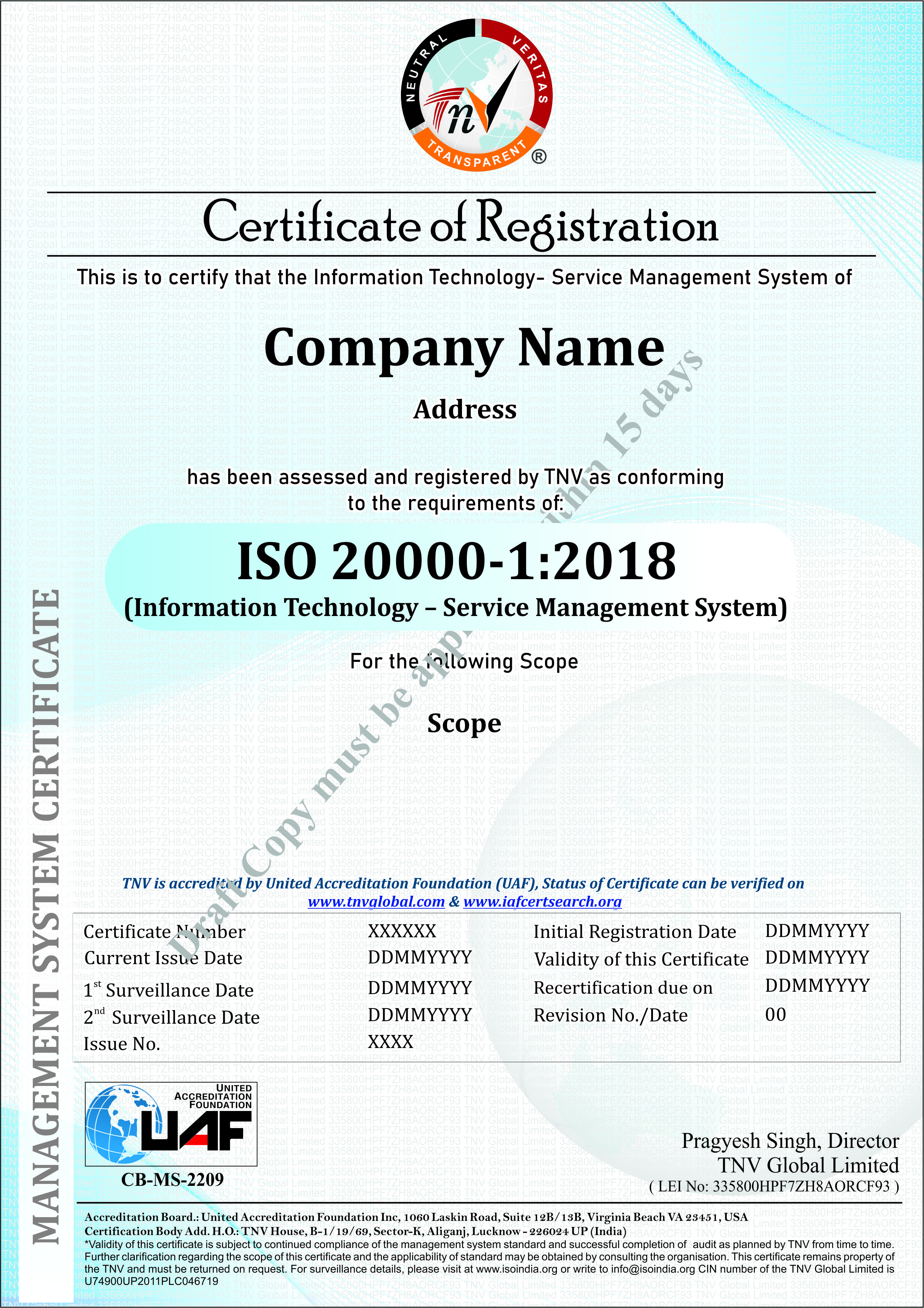
- ISO 20000-1:2018
- ISO 21001:2018
- ISO 14001:2015
- ISO 45001:2018
- ISO 22000:2018
- ISO 50001:2018
- ISO 27701:2019
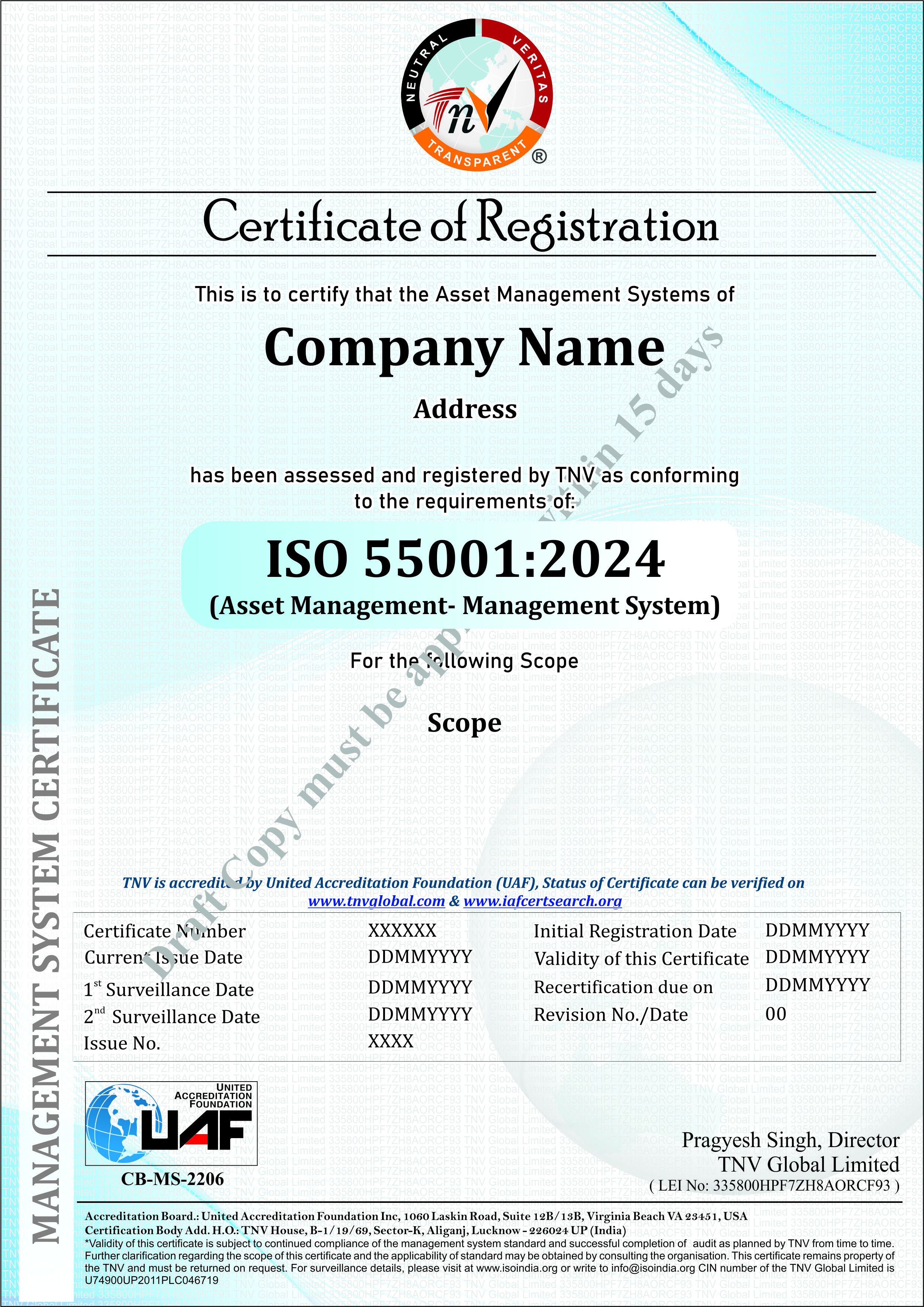
- ISO 55001:2024
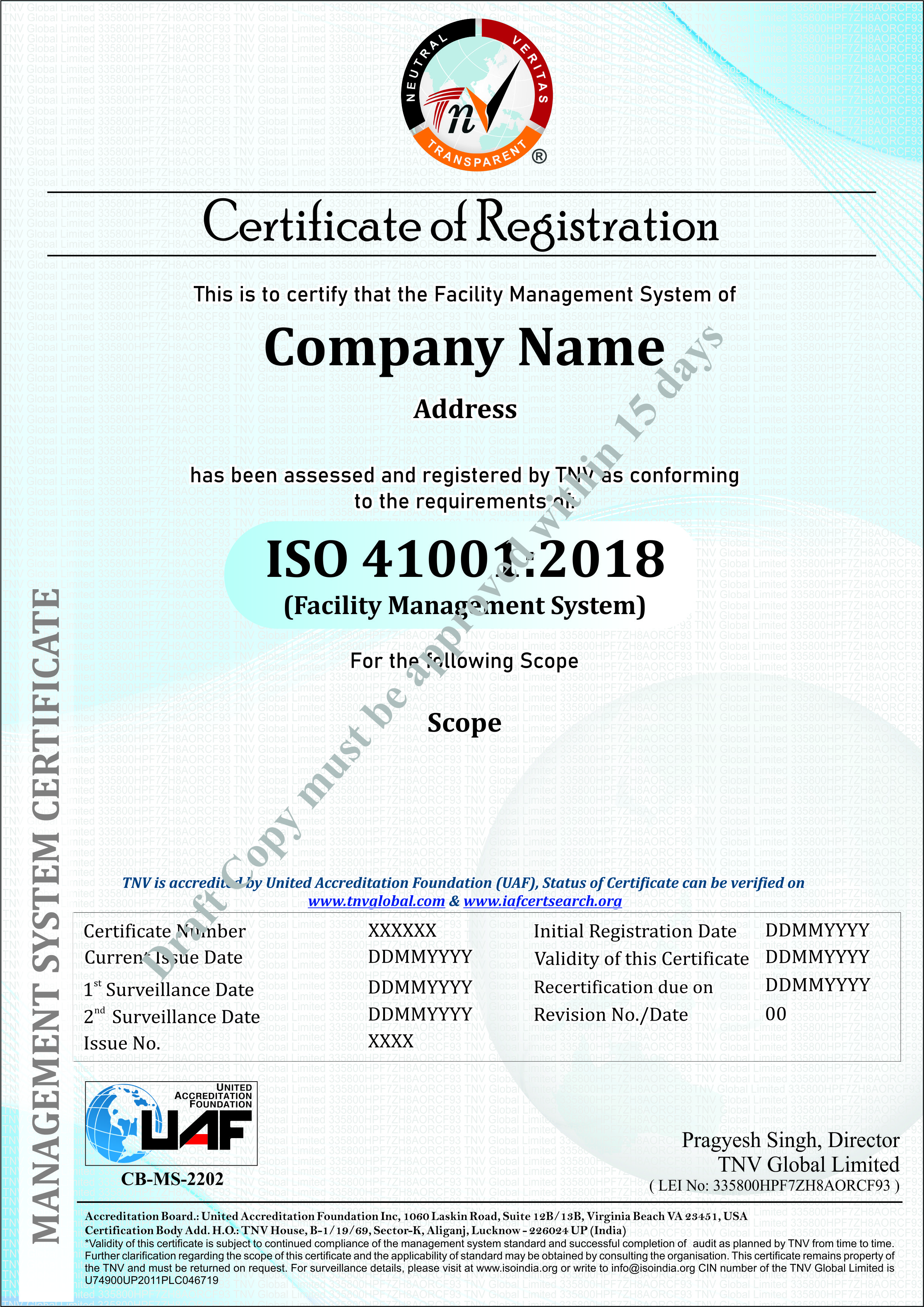
- ISO 41001:2018
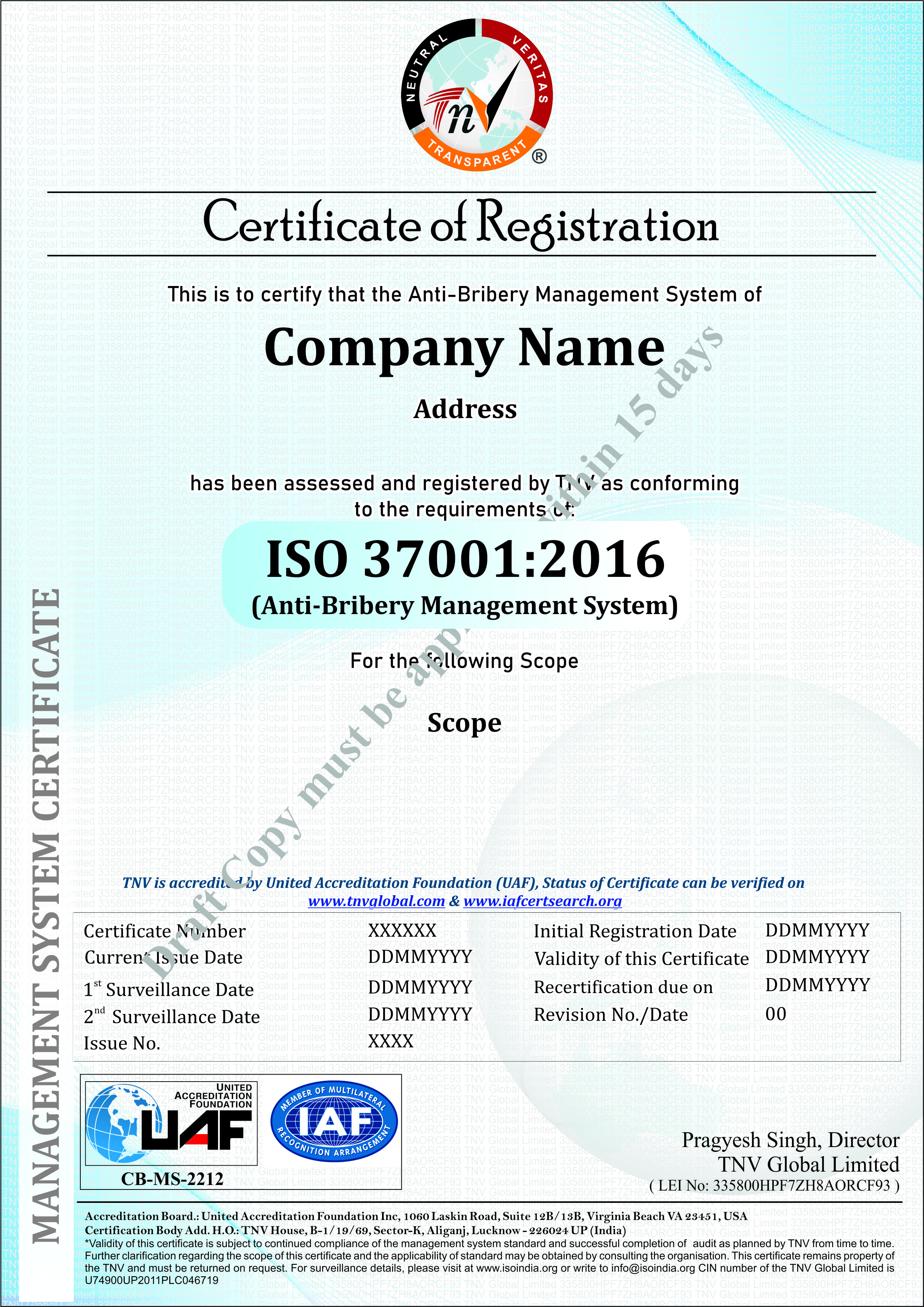
- ISO 37001:2016
- ISO 13485:2016
- ISO 42001 Certification
- ISO 20121:2024
- ISO 37301:2021
- ISO 27017:2015
- ISO 9001-2015
- ISO 27035 Certification
- ISO 27032 Certification
- ISO 27018 Certification
- ISO 27040 Certification
- ISO 27050 Certification
- ISO 29100 Certification
- ISO 9001:2026 — Upcoming Quality Management System Standard
- ISO 14001:2026 Certification
- ISO 37001:2025 Certification | Anti-Bribery Management System
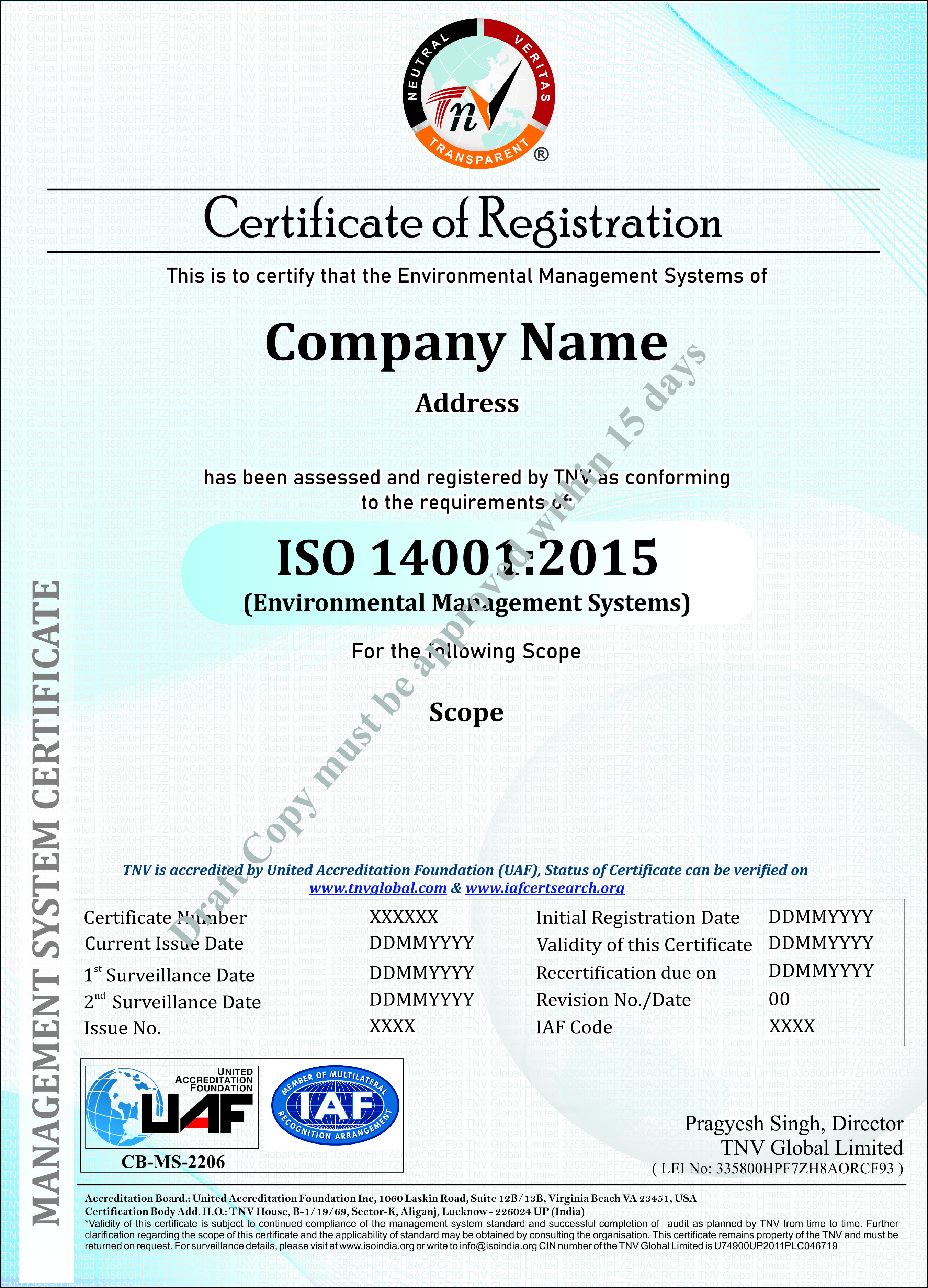
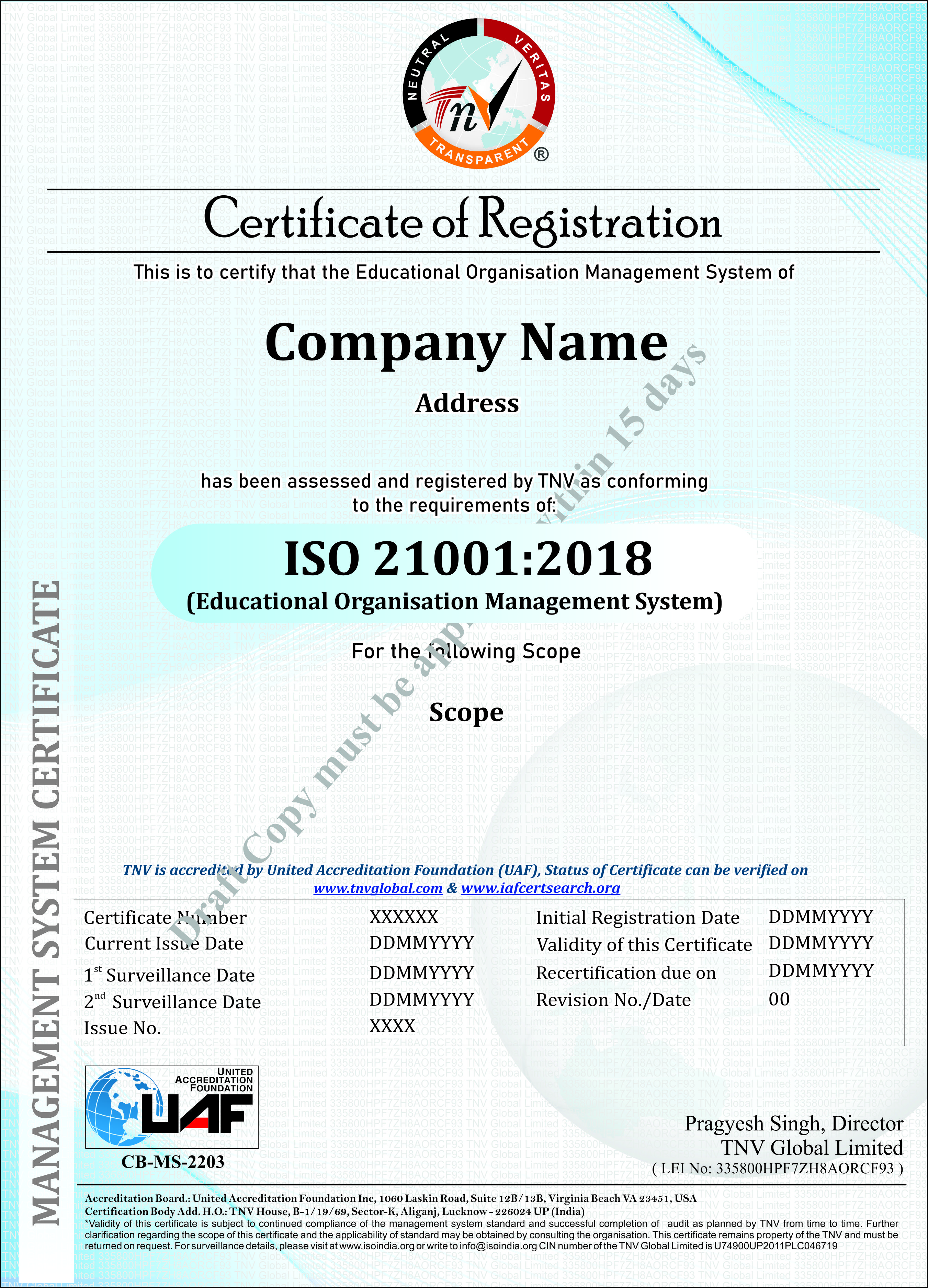
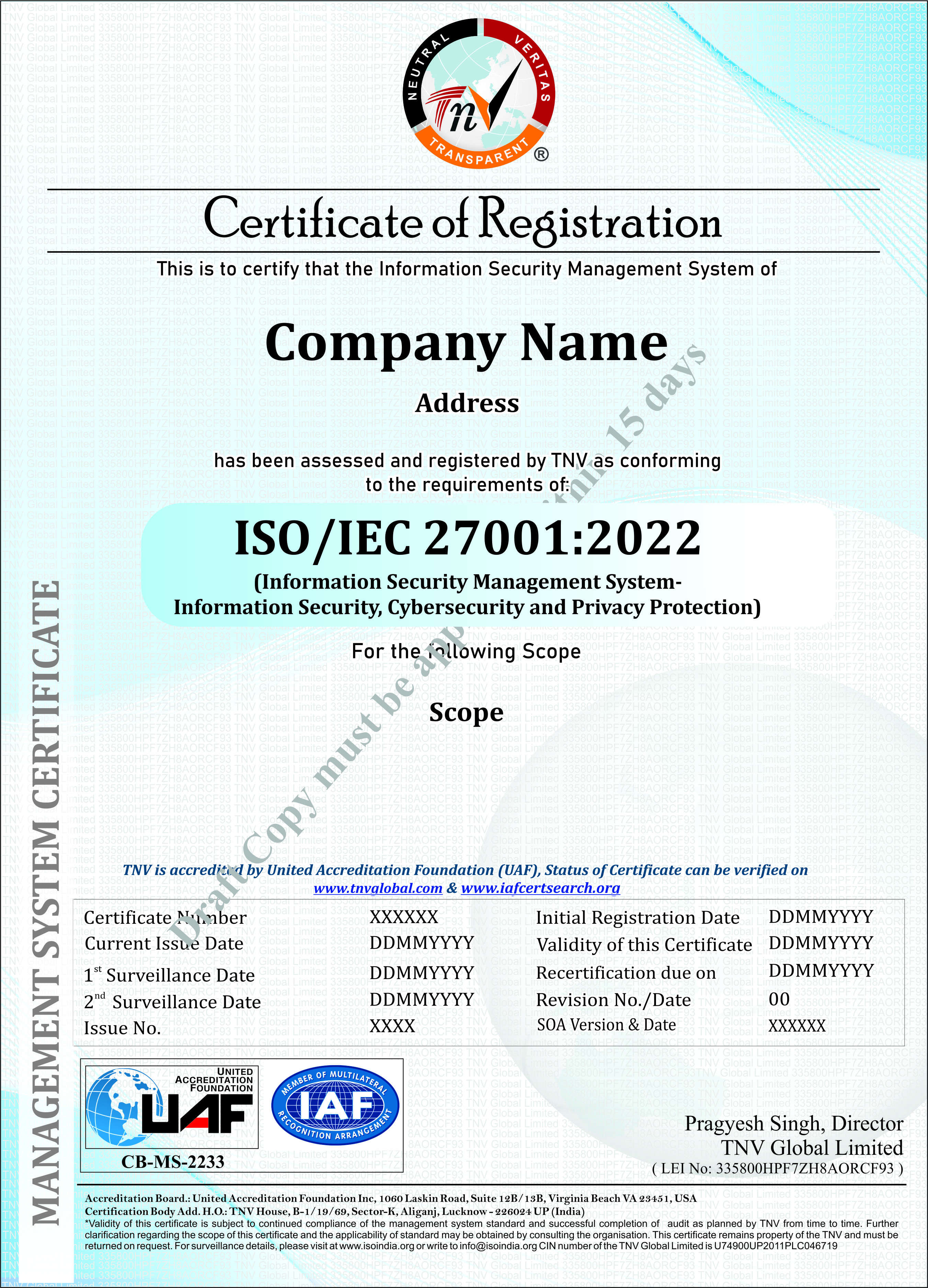
Certificate





 Sanjeev Sharma
We are Certified by TNV since last 6 years and we are absolutely happy and satisfied with the systematic approach of the Team. Best Wishes.
»
 PT. Sun Health Care
As always it was an excellent input that we got from TNV, looking forward to continuing a relationship with them. The assessment was very much a structured approach. Our team learned a lot Ari Rahmawati Director of PT Sun Health Care (El John Medica) »
 Innovation Imaging Technologies Pvt. Ltd
"May I take this opportunity to thank you for all your help in the arrangements and organisation for the Training of MD QMS Lead Auditor Certification Course attended. The course was very informative and structured to our requirements. I feel that the relationship that has been b »
 SSP Tech Consultancy Malaysia
SSP Tech Consultancy Malaysia is so proud on the long lasting relationship with TNV Certification Limited.
We have been working with TNV since 2010 and there were more than 80 clients have been certified in the field of ISO9001 , ISO14001, ISO45001 & ISO 13485.
We thank you For »
 Maria P. Belyanchikova
Dear Sir,
We kindly express gratitude for your
outstanding service and long-lasting
cooperation.
Since 2014 our companies in Russia, Moscow,
and United Arad Emirates, Dubai, have several
times ordered certification, surveillance and
audit from TNV Certification Limited and »
 Unnikrishnan Narayanan Namboodiri
Dear Sir,
It is with great pleasure that we at Inspirit Safety Solutions Pvt Ltd, are conveying our gratitude and appreciation to TNV Certification Limited for providing the best of services in the domain of
Management System trainings and certifications by accepting us as an a »

I have developed a great relationship with TNV Certification Limited.
I have undergone a few trainings with TNV training team & have
found their approach to be a highly professional & committed to
providing quality trainings & certifications. I am glad that I also have
had th »
© 2013 - 2027 . All Rights Reserved.